
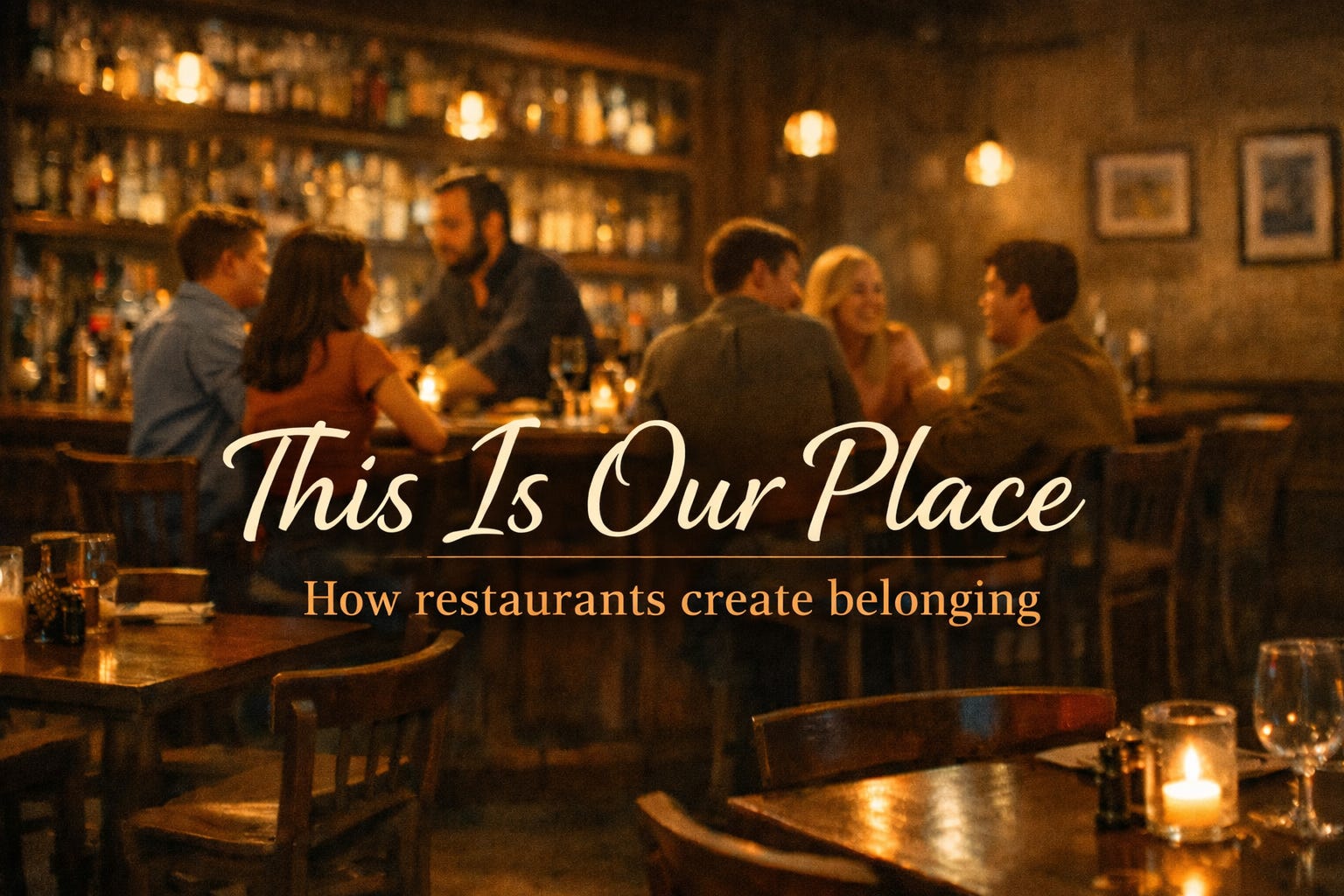
This Is Our Place

How restaurants create belonging — and why the number that matters most is how often guests return
I remember working as a consultant in a restaurant where the owner would tell servers not to cater to regulars.
“We are losing money every time they come,” she would say.
From her point of view, the logic seemed simple. Regulars knew the menu — not just today’s menu, but the ones from the past. They didn’t order the most expensive bottles. Sometimes they shared dishes. They were comfortable enough to linger.
But what she didn’t see was what those guests were actually bringing into the room.
Something as simple as this: no one likes walking into an empty restaurant.
Regulars bring people in by their presence alone.
Regulars don’t just occupy tables. They create attraction.
Their presence alone tells other guests that this is a place worth being.
They are the ones who bring visiting friends.
They are the ones who recommend the restaurant to neighbors.
They are the ones who celebrate birthdays, anniversaries, and quiet Tuesday dinners that slowly become traditions.
They are also the ones who stabilize a dining room.
When regulars are present, the room feels alive.
Staff recognize faces.
Conversations start easily.
New guests sense that something real is happening there.
Remove that relationship, and the restaurant slowly turns into something else — a place that serves food, but doesn’t create connection.
In that particular restaurant, the new policy worked exactly as expected.
Servers stopped giving extra attention to the regulars.
The familiar warmth disappeared.
The people who had once filled the room a few nights a week began drifting elsewhere.
And eventually the owner found herself standing in a half-empty dining room, wondering why — while the regulars had disappeared and the staff had begun leaving too.
Value Metrics
Hospitality is one of the few businesses where the most valuable guests are often the ones whose value is hardest to see on a single check.
Because their true contribution is not measured in one visit.
It is measured in the number of returns.
When I work with restaurant teams, I often encourage operations to look at their dining room through a different lens.
Instead of asking only about covers and averages, I ask how many VIPs versus first-time guests we have in the books.
Then I ask a simple question:
“Who has been here more than once this week?”
Twice. Three times… That person is not just a guest.
That person is becoming a loyal guest — a genuine VIP.
Not in the velvet-rope sense.
Not someone demanding special treatment.
But someone who has already begun forming a relationship with the restaurant.
When a guest reaches that point, the opportunity is enormous.
Remember their name.
Notice what they like to drink.
Welcome them with familiarity.
Because in restaurants, real VIPs are not created by spending the most money.
They are created by each return.
And the restaurants that understand this quietly build something stronger than a busy night.
They build a community around the table.
And that is — repeat this aloud —
genuine hospitality.
People First
What makes this possible is simple, though many operators overlook it.
Restaurants that create belonging invest in people first.
They invest in their teams — giving them the stability, confidence, and permission to build real relationships with guests.
And they invest in their guests — recognizing them, remembering them, welcoming them back not as transactions but as part of the life of the room.
When both sides of that equation are nurtured, something powerful begins to happen.
Employees start to care about the guests they see again and again.
Guests begin to care about the people who welcome them through the door.
That mutual recognition becomes the quiet engine of the restaurant.
Over time, it produces something more valuable than any promotion or marketing campaign.
It produces belonging.
And belonging always pays dividends — in loyalty, word of mouth, and the simple fact that people keep coming back.
Reviews
Which is why, when I read restaurant reviews, I rarely begin with the stars.
I read the language.
Because reviews quietly reveal whether a restaurant is creating belonging — or slowly losing it.
When I’m looking for a great restaurant, I look for reviews that sound like this:
“They remembered us from our last visit and even suggested a wine we loved.”
“This has become our spot on Friday nights.”
“Ask for Niko at the bar — he makes the whole experience.”
Those kinds of reviews tell me something important.
The restaurant is not just serving food.
It is building relationships.
Similarly, when I’m trying to understand whether a restaurant may be in trouble, the reviews often sound different.
They read like this:
“Food was good.”
“Service was fine.”
“Nice place but a bit expensive.”
Nothing is wrong with those sentences.
But nothing is alive in them either.
No people.
No moments.
No reason to return.
The restaurant has shifted from being part of someone’s life to being simply a place where a meal was evaluated.
And that difference matters more than a tenth of a star.
Because restaurants thrive on more than satisfaction.
Restaurants thrive on belonging.
Which raises an important question.
What creates that feeling of belonging in a restaurant?
Belonging is the moment when a guest stops feeling like a customer and begins feeling like they belong in the room.
It is subtle.
There is no announcement when it happens.
But something changes.
The guest walks in and the space feels familiar.
The staff recognize them.
Their preferences are remembered.
Their presence is welcomed, not processed.
The restaurant becomes part of their life.
Not because the food is perfect every time, but because the experience feels human.
And the interesting thing about belonging is that it is rarely created through grand gestures.
It is created through small acts repeated consistently.
A host remembering a name.
A server recalling the wine someone enjoyed last time.
A bartender asking,
“I just created this cocktail today, could you tell me what you think?”
A manager stopping by simply to say hello.
None of these moments are dramatic on their own.
But together they form a pattern of recognition that guests feel immediately.
People return to places where they feel seen.
And over time, those repeated returns create something powerful.
Guests begin to bring friends.
They celebrate milestones there.
They recommend the restaurant to neighbors.
The relationship grows quietly until one day they describe the restaurant with a simple phrase:
“This is our place.”
That sentiment is the clearest sign that belonging has taken root.
And once it exists, something important happens.
Guests become attuned to the nuances of the place.
They forgive a delayed course on a busy night.
They become advocates for the restaurant’s success.
Because they are no longer evaluating it as outsiders.
They are participating in it.
Belonging, in the end, is not built through marketing campaigns or clever promotions.
It is built through the daily discipline of recognizing people.
One name at a time.
One visit at a time.
One relationship at a time.
And over the years, those small moments accumulate until the restaurant becomes something more than a business.
It becomes a place people return to — again and again.
And when that happens, the restaurant stops being just a restaurant.
It becomes something simpler, and far more powerful:
“This is our place.”
A field note from the manuscript-in-progress, The Shape of Hospitality
This reflection is one of many from The Shape of Hospitality — a manuscript and unfolding practice on what it means to host with intention, integrity, and care.
If this piece moved you, consider subscribing to explore future chapters.
Read. Reflect. Respond.
And if it resonates — share.
By Rafael Delgado
© OINOSLOGO LLC 2026
@oinoslogo
from the forthcoming work The Shape of Hospitality