
Welcome Is the Work

Why welcome is both a feeling and a capital decision
Restaurants don’t exist to sell food and drinks—those are simply the medium.
Food and drink matter.
That’s now assumed.
They must be done well.
But they are not the point.
The real work for restaurants is creating welcoming experiences.
This is not a new concept… this idea actually predates modern restaurants.
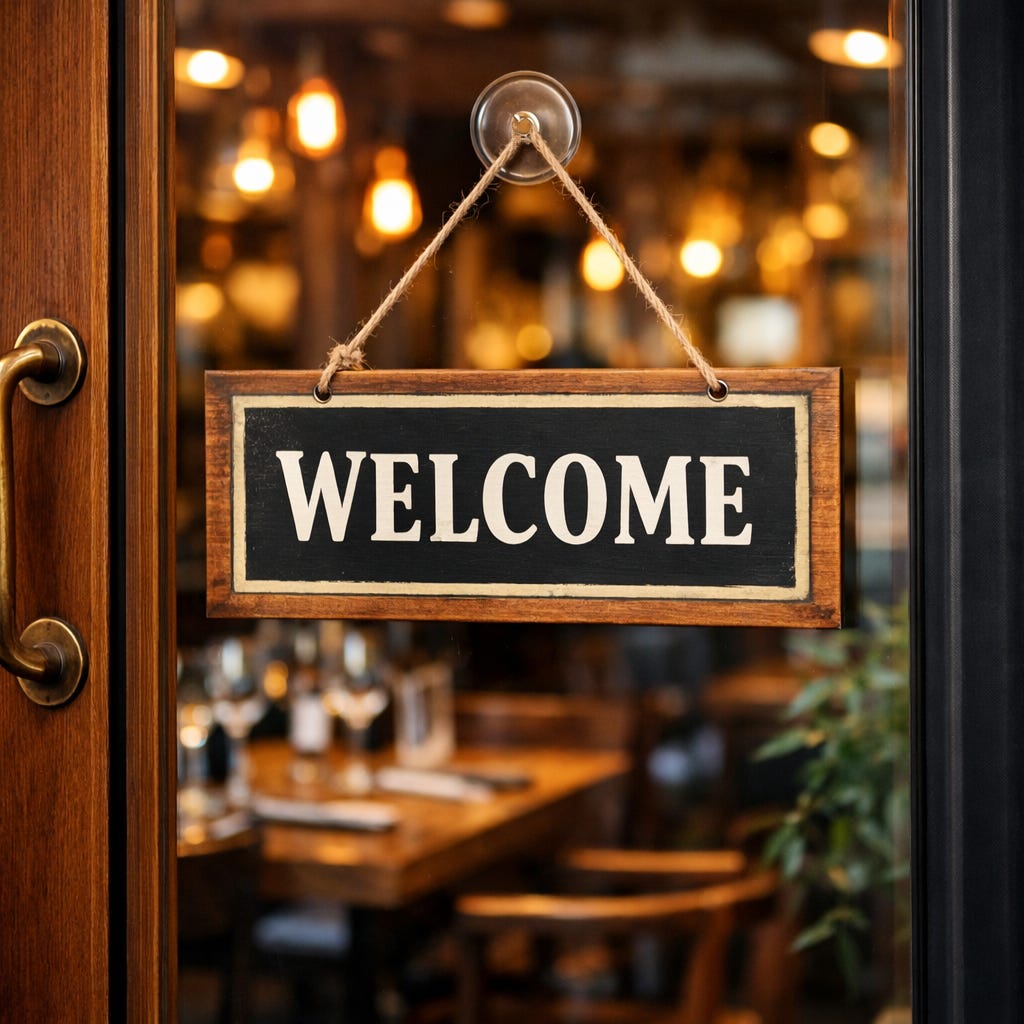
The word restaurant comes from the French restaurer—to restore, to bring back to strength. Early restaurants were not designed to impress, scale, or optimize. They existed for the purpose of offering restoration, care, and relief.
Food and drink were simply how that care was delivered.
That restorative work did not belong to restaurants alone.
For most of human history, the third place took many forms: churches, town plazas, cafés, taverns, diners, barbershops, libraries, front stoops. These were places where people could arrive without explanation—where presence alone was enough.
There were no conditions attached.
You didn’t have to explain yourself.
You didn’t have to justify your time.
You didn’t have to keep ordering to stay.
Those places didn’t disappear by accident. They eroded through choices and pressures that reshaped daily life—secularization, privatization, longer work hours, digital saturation, rising costs. The conditions that once made lingering normal were systematically removed.
Restaurants now risk becoming the next eroded third place when welcome is expected but not capitalized.
The need those places met, however, did not disappear.
It relocated.
Today, restaurants are carrying more than food and drink. They are being asked to hold community, ritual, celebration, and refuge—often without the cultural support or economic margins those older third places once had.
This is the inflection point.
When people hear premium, they often think luxury or exclusivity. But what hospitality now requires in practice is care and intentional presence.
It means someone noticed how you arrived.
It means the pace of the room allows you to exhale.
It means the experience has been shaped so you don’t have to manage yourself to belong.
This is not indulgence.
This presence is the meaning of genuine hospitality.
This presence however carries a cost because care is emotional labor.
Care requires emotional safety ….. and safety doesn’t happen accidentally—it has to be created.
Welcome is a feeling—but it is also a capital decision. Guests experience hospitality emotionally, but it is produced structurally. Presence, care, and safety are funded through time, staffing, training, and margin. Retaining trained staff is part of that investment. When people are developed and then lost to burnout, instability, or underfunding, the business isn’t suffering a labor issue—it is depreciating an asset it paid to build. Hospitality does not compound through churn. It compounds through continuity. If welcome is part of the value proposition, the systems that sustain trained, stable teams must be capitalized accordingly.
We cannot offer neighborly hospitality without funding the systems that sustain it.
This is why the work cannot be discounted without being diminished.
You can ask for presence and demand volume and speed at the same time…. while removing the conditions that allow it to exist…
But there’s a price to pay.
As traditional third places disappear, hospitality becomes presence-based by necessity—not as a trend, not as a luxury, but as a response to cultural loss.
Food and drink remain the medium.
But…
Welcome is the work.
Not the scripted version.
A way of showing up—with intention, and awareness of what this craft asks us to hold.
The Shape of Hospitality
Written by Rafael Delgado | OINOSLOGO LLC
Copyright © 2026